


Course Introduction / Overview
This is an ideal degree for anyone considering an engineering career in aviation. It will prepare you to work in design, airworthiness, aviation management, logistics, systems integration, support, manufacturing, and aircraft maintenance and air transport economics.
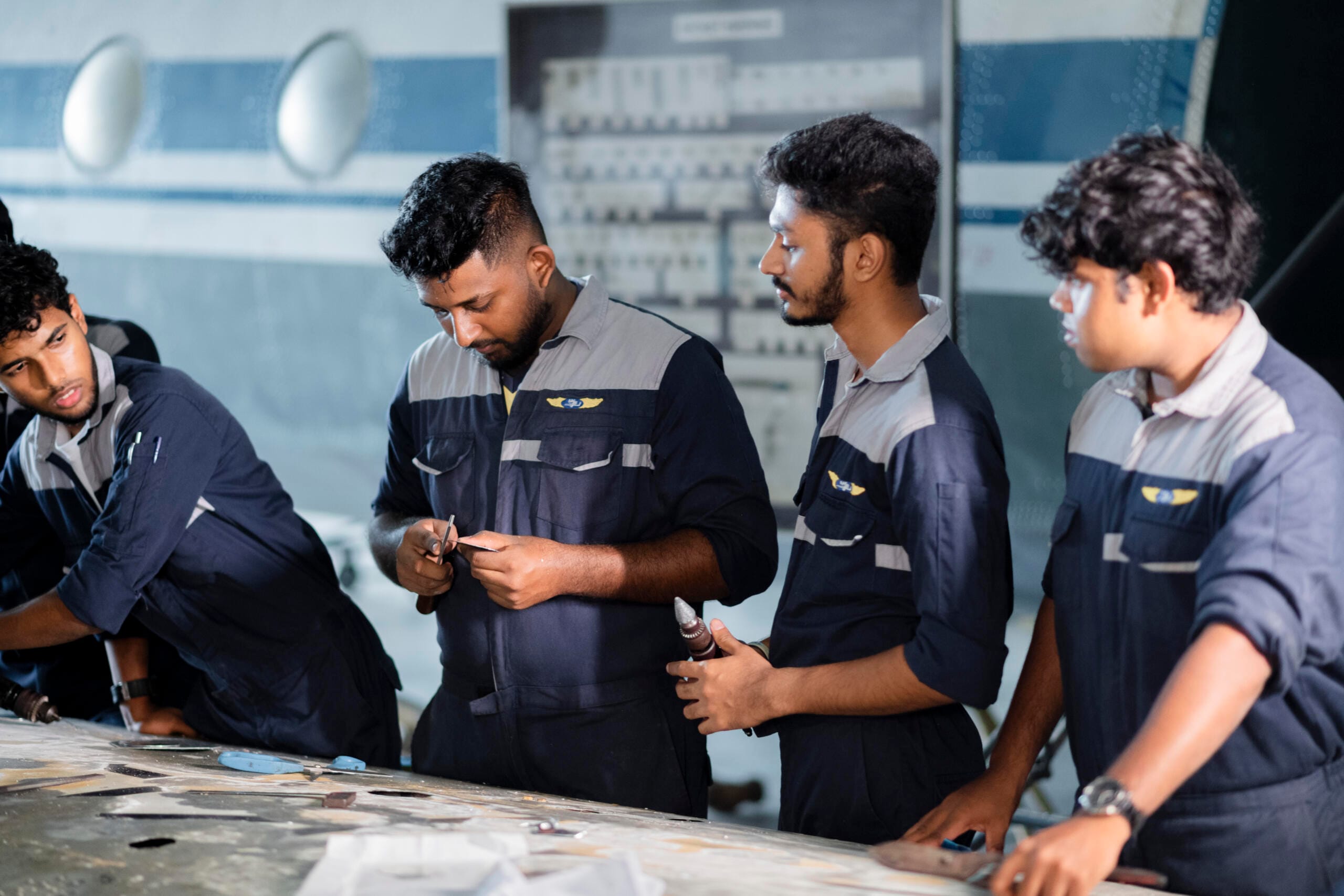
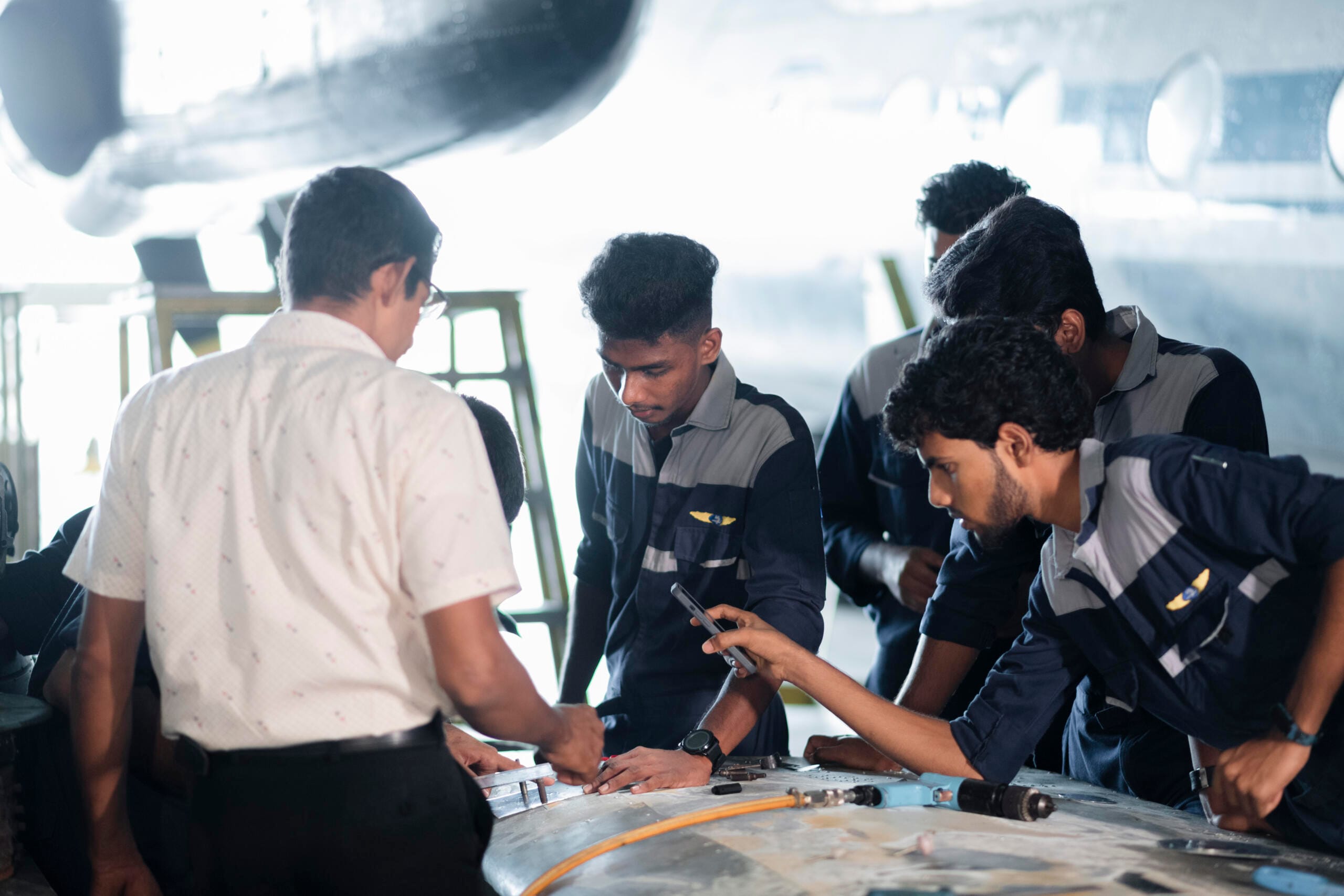
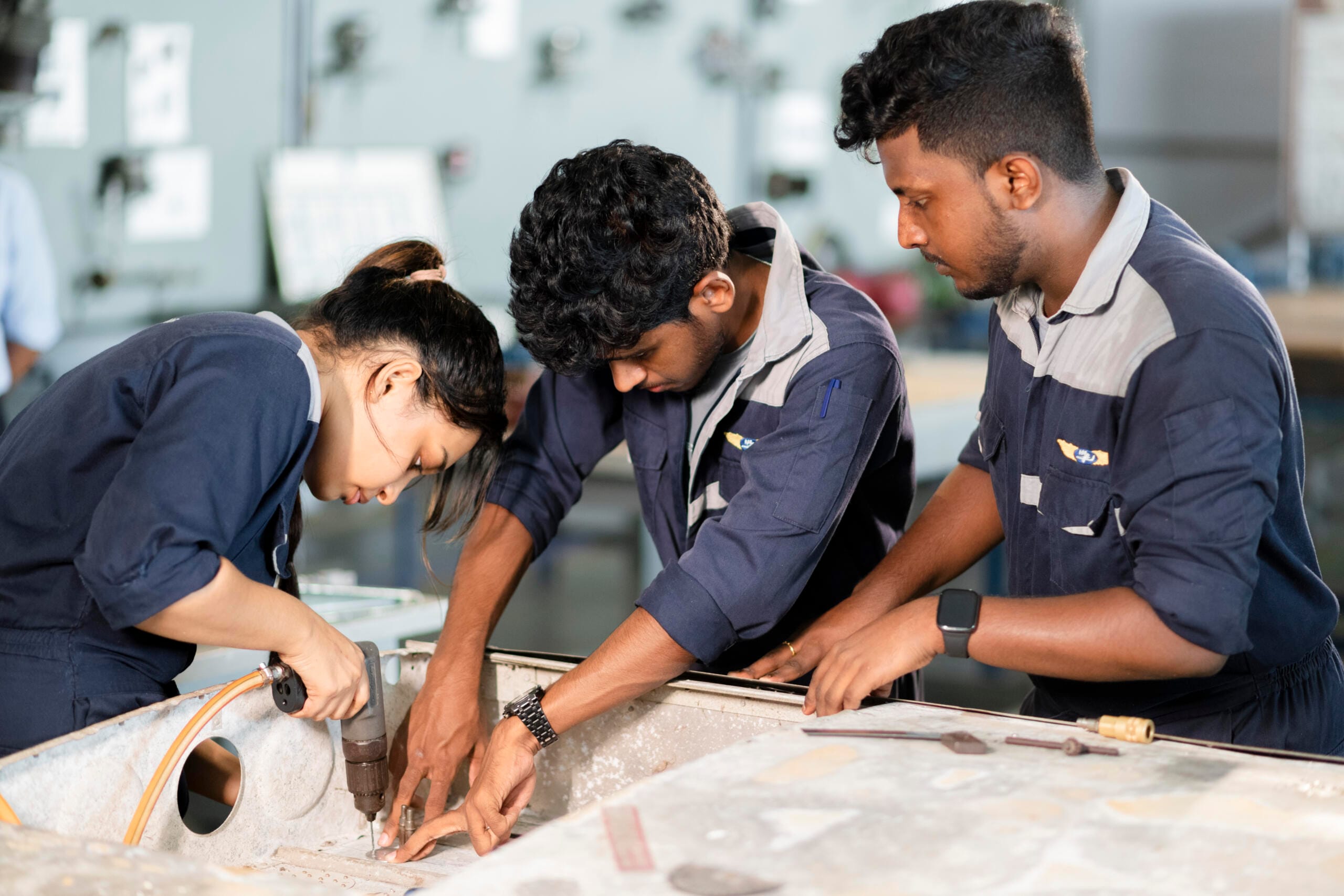
Studies include aerodynamics, propulsion, structures and materials science and the performance of aircraft. Through practical work in laboratories and workshops, you’ll apply the engineering principles you learn.
This degree will also develop career skills such as effective communication, presentation, team-working, and planning and project management.
This is a 03 years Full Time learning process and First two years of study delivered at AAC in Sri Lanka and Third / Final year of study is conducted at Kingston University in London, United Kingdom
Course Content
Following modules will be completed during the first two years of the programme at Asian Aviation Centre.
In year 1, you will acquire the fundamental engineering knowledge and skills building a solid foundation for students to undertake a deeper study in year 2. You will have the opportunity to carry out hands-on practical work in laboratories and workshops throughout the programme. Most modules are designed to develop key employability skills such as communication, presentation, team-working, and planning and project management.
In Year 1, there is a clear structure and guidance for your learning, with an emphasis on the acquisition of fundamental engineering knowledge and skills (e.g. Mathematics and IT), practical skills, design skills and the initial development of Future Skills.
Core Modules
Navigate for the Professional Engineer (15 credits)
Students are introduced to their course learning aims and consider their anticipated learning targets from induction to graduation. Students are guided to identify and take ownership of their personal academic journey through the development and application of academic skills aligned to KU Graduate Attributes and their discipline-specific professional body learning outcomes.
Engineering Mathematics (15 credits)
The aim of this module is to provide a thorough background in engineering mathematics and equip students with the mathematical skills essential for solving engineering problems. The topics introduced will serve as basic tools for studies in many engineering subjects. This comprises algebra, functions, statistics and probability, trigonometry, calculus, differential equations and vectors.
Thermodynamics and Fluid Mechanics (15 credits)
This module introduces mechanical engineering students to the fundamentals of fluid mechanics and thermodynamics. The fluid mechanics section covers the fundamental properties of fluids along with the main basic conservation equations and their engineering applications. It also introduces the concept of dimensions and the SI units of measurement.
Introduction to the Aviation Industry (15 credits)
This module introduces the students to the basic knowledge of the aviation industry and the options for various career opportunities. The module is mainly delivered through face-to-face lectures and some tutorials. The module also introduces students to the challenges the industry may face in the future.
Engineering Design and Manufacture (30 credits)
The principal aim of this module is to provide students with a flavour of what is involved in engineering design and to develop the good academic and professional practice needed to succeed during the course and attain professional status.
The module introduces the key aspects involved in planning a project from start to finish, design processes incorporating a sustainability agenda, building an awareness of the interactions across various disciplines, regulatory frameworks and Health and Safety procedures.
Engineering Mechanics and Materials (30 credits)
The module introduces students to the fundamentals of structural analysis (statics and dynamics) and the mechanical behaviour of a broad range of engineering materials. The mechanics part provides an understanding of the behaviour of particles and rigid bodies whilst stationary and in motion. Bodies such as trusses in equilibrium are studied and the external and internal parameters including force, moment, stress, or strain are defined and calculated.
In Year 2, there will be an increased expectation of independent study, supported by a reduced emphasis on the use of traditional lectures. You will study the engineering principles underpinning aircraft technologies such as aerodynamics, propulsion, structures and materials science and performance of aircraft. You will study aircraft maintenance operations, aircraft systems, airworthiness, and air transport economics. You will also learn to design and make aircraft structures using computational skills such as CAD and FEA. You will have problems based learning and interdisciplinary group work to tackle a live, real-world problem supplied by a well-known company or organisation.
Core Modules
Exploring Engineering Project Management (15 credits)
This module considers the principles and practices for the design and management of engineering projects. The nature of engineering project management is discussed in the context of constraints on quality, time, risk, and sustainability. The module broadens the student’s knowledge of how organisations undertake and monitor projects.
Aviation Safety (15 credits)
The module aims to familiarise students with the knowledge of basic theories and methodologies for safety analysis and risk assessment in different aviation environments and with the concept and practicality of a ‘Safety Management System’. It also used to reinforce the applied statistics that has been taught earlier in the module.
Aircraft Dynamics and Control (15 credits)
This module is designed for students from a range of aerospace related programmes. It provides understanding of the principles of flight dynamics, performance and how these can be used to perform stability, control systems and performance analysis
Aviation Operations (15 credits)
The purpose of this module is to introduce students to the applied mathematical techniques that enable operational organisations to achieve efficiency and productivity. The focus of the teaching is on airline operations, but the techniques taught are equally applicable to other transport industries which share similar operational challenges. It is also used to reinforce the applied statistics that have been taught earlier in the module.
Aerospace Engineering (30 credits)
The basics of aerodynamics, aircraft performance and aerospace propulsion are introduced with a view to provide the ability to analyse, formulate and solve elementary problems. Students will have the opportunity to apply the theoretical knowledge into practice in this module via examination.
Aircraft Systems (30 credits)
This module is designed for students from a range of aerospace-related programmes. It provides an understanding of how principles of aerodynamics, propulsion, structures and materials science all determine the functions, configuration and performance of aircraft systems.
In Year 3, you will study advanced materials and structures, propulsion and performance, aircraft maintenance, airworthiness and air transport economics. The assessment tasks in Year 3 focus on the real world-engineering activities that enhance students’ employability. In Year 3, you will also learn about maintenance logistics, maintenance cost drivers and the key aspects of project planning. You will apply business methods to assess the economic and financial aspects of air transport and/or engineering projects. In this final year, you will be expected to select and apply requisite practical skills in your own independent research work in the Individual Project module.
Core Modules
Applying Business Management (15 credits)
Students will demonstrate the ability to apply their developing professional skills competencies in their chosen area and will ensure they have a broad understanding of the business environment in which professional activities are undertaken. The module will develop the students’ technical, management and interpersonal skills required to perform in a team environment and prepare the students for employment and entrepreneurship.
Aircraft Propulsion and Performance (15 credits)
This module is designed for students from a range of aerospace related programmes. It provides understanding of the principles of aerodynamics and thermodynamics and how these can be used to perform propulsion calculation and performance analysis. Performance of both fixed wing and rotary wing aircraft configurations are studies in this module.
Advanced Materials and Aircraft Structures (15 credits)
This module provides an understanding of the fundamentals and the application of advanced engineering materials for aerospace applications. This module also covers an introduction to aircraft structures and engineering beam theory. The module covers approach to design components based on materials properties are demonstrated and areas of the design process are methodically examined. The module is primarily delivered through interactive lectures, tutorials, and problem-solving, flipped classes.
Aircraft Maintenance Group Project (30 credits)
Students will be given a group exercise in which they work together to produce a realistic and cost effective maintenance solution for an airline operation. The details of which (routes, flight schedule, aircraft details etc.) are provided by the course team. The project involves reviewing the “scenario” to determine the exact requirements, planning for successful completion of the project, identifying options and determining costs through research, analysing data collected and formulating an evidence-based solution and presenting the findings. As part of the project, students will produce a project plan, do a group presentation, produce a substantial written report, and maintain a project log book.
Air Transport Economics (15 credits)
Throughout their studies, students have studied material that has been focused on a specific role or roles within the air transport industry whether it be aircraft design, maintenance, operations or repair and overhaul. The aim of this module is to take a step back and explore how employers within the various sectors of the air transport industry combine all these functions in order to make a profit.
Individual Project (30 credits)
Working on a topic of their own choosing, the student, with minimal guidance from their supervisor, should apply approximately 285 hours of individual time into the analysis of the problem and determination of the best solution or course of action. That analysis can take a variety of forms ranging from an in-depth comparison of a number of already documented potential solutions to the collection and comparison of experimental and theoretical data. The topic investigated should ideally be of an aircraft operational or engineering nature.
The Course Management Staff & Teaching Team
BSc Module lecturers with related modules
Director Studies
Wg. Cdr. Lasantha Gunasinghe SLAF (Ret’d)
Manager Quality Assurance
Mr. Dhananjaya Weerasinghe
Course Coordinator
E.M.S. Gunawardhana BEng, MSc, MRAeS
Mr. A M Abeywaradhana – (USP) Ex SLAF Technical Instructor (Specialized in Piston Engines)
- Piston Engines
- Airframes & Systems
- Propellers
- Human Factors
Mr. N G Chandrakeerthi – Ex SLAF Airframe Specialist
- Live Maintenance Training
Mr. I G B Chandrarathna – ABL (B1.1, B1.2, B3) Aircraft Maintenance Engineering Training
- Maintenance Practices
Mr. A R De Silva – Ex SLAF Airframe and NDT Specialist
- Workshop / Aircraft Maintenance Practicals
Mr. B G Mahindasiri – AML (B1.2, B2) Diploma in Radio/ Radar Technology
- Electrical and Electronic Fundamentals
- Avionics
Mr. H M Mantriratne – Ex SLAF Technical Instructor (Specialized in Gas Turbine Engines)
- Airframe & Systems
- Materials & Hardware Maintenance Practices
Mr. H N P Samaranayake – ACS, Diploma in General Comp. Programming
- Information Technology
Mr. M D B Silva – AML (B2) Ex SLAF Technical Instructor
- Electrical Engineering Maintenance Practices
Mr. D Weerasinghe – MSc in Aircraft and Aero-engine Maint. (Kiev) LL.B (OUSL), MBA (Colombo), Cert (Level 4) in Assessment & Workplace Training (AUS)
- Air Legislation
Mr. H S P A Wickrama – Ex SLAF Technical Instructor (Specialized in Aircraft Engines)
- Workshop / Aircraft Maintenance Practicals
Mr. C Ferdinandez (USP) – Ex SLAF Technical Instructor (Specialized in Helicopters and Supersonic Aircraft)
- Airframe & Systems
- Aerodynamics
- Helicopters
Mr. E M S Gunawardhana – fdEng Aircraft Eng, BEng (hons) Aircraft Eng (Kingston), MSc Aero Eng (Queen Mary)
- Physics
Mr. W K Lankapura – BTech (Hons) in Manuf. Tech, ND in Production Tech, Adv Dip (C&G)
- Mathematics
- Physics
- Electronics
Mr. U D L P Gunasinghe – BSc (Defence Studies) Aeronautical Eng (KDA) AML (B1.3), Ex SLAF Technical Instructor
- Maintenance Practices
- Airframe & Systems
- Materials & Hardware
Ms. R G B Ranatunga – BSc (Hons) in Civil Engineering LJMU, UK
- Engineering Drawing Mathematics
Ms. H M K S Ranasinghe – BSc in Applied Mathematics and Computing, University of Jaffna
- Mathematics
- Physics
Mr. P K Wadanambi – Dip in Mechanical Engineering, Ex SLAF Technical Instructor
- Workshop/ Aircraft Maintenance Practicals
Mr. W M W W Karunaratne – Dip in Engineering (Electrical & Electronics) Dip of Associate Eng (Aero Electrical), Ex SLAF Elect. & Instrument Instructor
- Electrical and Electronic Fundamentals
- Avionics
Awarding Body
Asian Aviation Centre,
Colombo,
Sri Lanka
Course Duration
Every year the programme begins in the month of January (around third week) in line with the release of local GCE Advanced Level results.
This is a three year degree programme with 02 + 01 arrangement. First two years of the study programme will be conducted at the Asian Aviation Centre, Colombo Airport, Ratmalana in Sri Lanka.
For the third and final year of studies, students would have to proceed to Kingston University, London, United Kingdom and graduate.
Students may progress to further studies or make use of the currently available two years post study work visa programme to stay back and continue to work in United Kingdom.
Entry Requirements
Direct Entry
-
GCE A/L 03 Credit Passes
Three (03) Credit Passes at GCE A/L with Physical Science (Mathematics Stream) or equivalent to a minimum of 112 UCAS points.
-
GCE O/L 05 Credit Passes
Five (5) Credit Passes at GCE O/L Including credit passes for Mathematics and English.
Alternative Entry
-
Engineering Foundation
Engineering foundation Students with less than 112 points may get through a foundation programme (Engineering Foundation pathway to BSc. (Hons) in Aerospace Engineering).
-
Other Equivalent Qualifications
Students with other equivalent or qualifications may be considered as case by case basis.
UCAS Tariff Points
| Grade | Points |
|---|---|
| A | 56 |
| B | 48 |
| C | 32 |
| D | 24 |
| S/E | 16 |
The minimum entry qualifications for the programme are:
From A levels: 112 points from A Levels ( Local A/L or International A/L) Passes in Physical Science stream.
BTEC: Extended Diploma or Diploma: In Engineering or related subject (Aerospace/Aeronautical/Electrical/Electronic/Manufacturing and Mechanical Engineering considered) – 112 points.
Access to HE in a suitable Engineering subject considered: Equivalent of 96 points with all Maths and Science modules at Level 3 passed with Merit grades.
Plus: GCSE (A*-C) minimum of 5 subjects including English Language and Mathematics.
Students with lesser than 112 points may follow a foundation programme ( Engineering Foundation pathway to BSc. (Hons) in Aerospace Engineering ) for a period of 3 ½ or 8 months and enter the 1st year of the degree programme.
AAC Engineering Foundation programme (4 month) Two (02) Passes in GCE A/L Examination to Include the Subjects of Combined Mathematics, Physics chemistry or ICT and a minimum of five (05) credit passes at GCE O/L including Credit Passes for Mathematics and English Language.
AAC Engineering Foundation programme (8 month ) having sat for A/L’s in Physical Science stream or having a pass at A/L in Biological Science stream or have two (02) passes at A/L in Technology stream . All with a minimum of five (05) credit passes at GCE O/L including Credit Passes for Mathematics and English Language.
Fees and Payment Structure
(All payments are subjected to Government Tax)
-
First Two Years LKR 1,717,000
-
University Fee GBP 1,500
Contact the Information Centre for Flexible Fee Structures and Commencement dates via info@aac.lk or +94 11 451 0303/4.